Shopping Bag
No products in the cart.

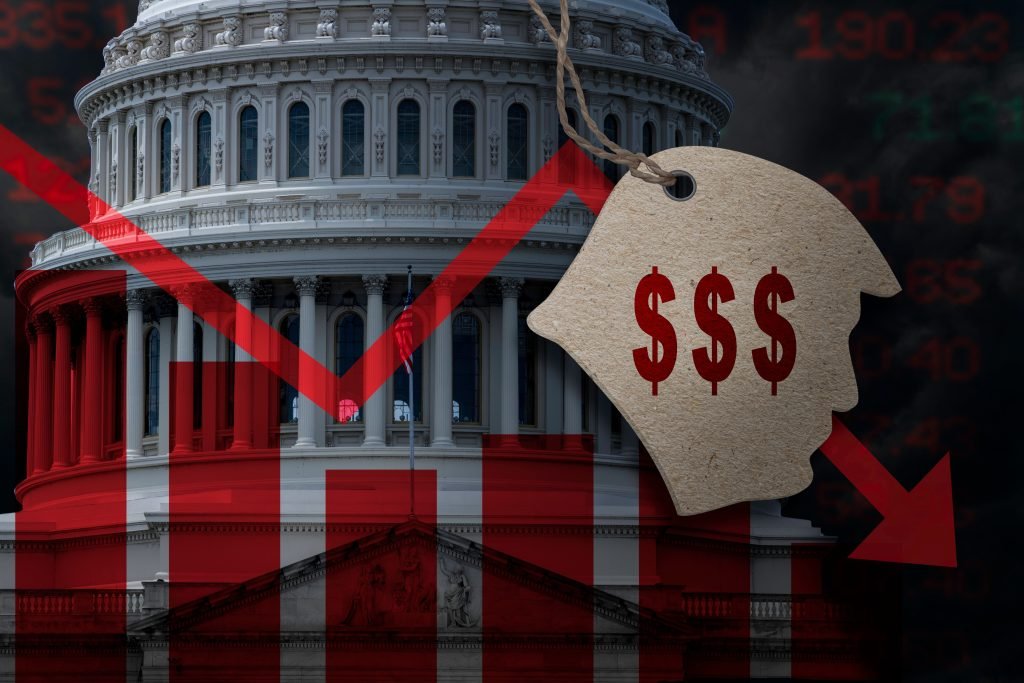
America is going through mounting warnings about its long-term fiscal stability, with deficits, debt ranges, and political gridlock converging into what some economists describe as an unsustainable trajectory. As policymakers debate the best way to “repair” the issue, buyers are more and more asking a extra rapid query: what occurs to markets—and particularly gold—if confidence in authorities funds begins to crack?
The present fiscal outlook is now not outlined by non permanent crises—it’s more and more structural. The federal authorities continues to spend excess of it collects, with deficits approaching $1.9 trillion yearly and cumulative debt rising at a fast improve, as measured in share phrases relative to GDP. Current information from official sources, such because the Congressional Price range Workplace, verify these traits and spotlight the persistent nature of the imbalance.
A number of forces are driving this imbalance:
Except there are vital adjustments in financial circumstances, the fiscal outlook is anticipated to stay on its present trajectory.
The result’s a fiscal trajectory extensively described as “unsustainable,” with debt anticipated to develop quicker than the financial system for many years.
In contrast to previous cycles, this imbalance will not be tied to a single recession or struggle—it’s embedded within the system itself.
In contrast to an organization, the U.S. authorities can not technically “go bankrupt” within the conventional sense. Nonetheless, insolvency issues come up when authorities debt grows so massive that markets start to query the federal government’s capability—or willingness—to handle it sustainably.
This danger manifests in a number of methods:
| Threat Kind | Mechanism | Market Influence |
|---|---|---|
| Rising yields | Buyers demand increased returns for holding Treasuries, although sure financial components—corresponding to demographic traits or financial coverage shifts—also can create downward strain on rates of interest | Bond costs fall, borrowing prices spike |
| Foreign money debasement | Cash creation used to finance deficits | Greenback weakens, inflation rises |
| Fiscal dominance | Central financial institution pressured to assist authorities financing | Lowered coverage independence |
| Confidence shock | Sudden lack of belief in U.S. debt markets | Volatility throughout all asset lessons |
Investor demand for Treasuries is pushed primarily by perceptions of fiscal sustainability and macroeconomic stability.
The idea of fiscal dominance—the place financial coverage turns into subordinate to debt financing—is more and more cited as a long-term danger if deficits stay unchecked. Fiscal dominance also can threaten the Fed’s independence, because the central financial institution might face strain to prioritize authorities financing over its financial stability mandate.
Whereas economists broadly agree on the necessity for deficit discount, the political path ahead stays unclear.
Traditionally, significant fiscal consolidation has required bipartisan cooperation—one thing more and more tough in a polarized atmosphere.
The trade-offs are politically expensive:
This stalemate has led to repeated delays in addressing long-term debt points, growing the chance that markets—not policymakers—ultimately drive changes.
Central banks, led by the Federal Reserve in the USA, are pivotal in navigating the challenges of a fiscal disaster. Their core mission is to keep up financial stability—balancing inflation, employment, and the sleek functioning of economic markets—even because the federal authorities’s debt burden grows.
When the nationwide debt continues to climb and the debt-to-GDP ratio reaches historic highs, because the Congressional Price range Workplace warns, central banks face mounting strain. The Federal Reserve’s major lever is financial coverage: by adjusting rates of interest, it will possibly affect borrowing prices, demand, and in the end the tempo of financial progress. Within the early levels of a debt disaster, the Fed might decrease rates of interest to ease the federal government’s curiosity prices and assist the broader financial system. Nonetheless, this technique can create upward strain on inflation, eroding the buying energy of the greenback and elevating issues about the true worth of financial savings and investments.
To additional stabilize monetary markets, central banks might deploy quantitative easing—buying authorities bonds and different property to inject liquidity and preserve treasury yields in examine. Whereas this might help cut back rapid debt servicing prices and assist asset costs, it additionally dangers fueling increased inflation and distorting the treasury market, particularly if used excessively. Over time, persistent intervention can undermine confidence within the central financial institution’s independence and its capability to regulate inflation.
The Federal Deposit Insurance coverage Company (FDIC) additionally performs an important function by safeguarding deposits and sustaining belief within the banking system, particularly in periods of economic stress. This backstop helps stop panic and ensures that cash market funds and mutual funds stay steady funding choices, whilst volatility rises in different asset lessons.
But, central banks aren’t resistant to the results of extreme debt. As curiosity prices devour a bigger share of tax income, the federal authorities’s fiscal flexibility diminishes. If international buyers or major sellers cut back their demand for U.S. bonds, the Fed could also be pressured to intervene extra aggressively, risking a debt spiral and additional inflation dangers. In such eventualities, the true rates of interest might flip detrimental, driving buyers to hunt inflation hedges like gold, which has traditionally preserved buying energy in periods of foreign money debasement and financial instability.
For buyers, these dynamics underscore the significance of diversification. Allocating to gold, alongside mutual funds and cash market funds, might help hedge inflation and shield portfolios from the volatility that usually accompanies a debt disaster. Because the accountable federal finances debate continues and the financial progress fee struggles to maintain tempo with the rise in public debt, sustaining publicity to a spread of asset lessons turns into much more essential.
Finally, managing a fiscal disaster requires coordinated motion between central banks, the federal authorities, and regulatory our bodies. By pursuing accountable fiscal insurance policies—balancing spending, tax collections, and sustainable financial progress—whereas utilizing financial coverage judiciously, policymakers might help restore confidence and stability. For buyers, staying vigilant and proactive in portfolio development is vital to navigating the dangers and alternatives that come up because the U.S. confronts its long-term debt challenges.

For many years, U.S. Treasury debt has been thought-about the worldwide “risk-free” benchmark. However as debt ranges rise and deficits persist, that notion might progressively shift.
Key indicators to look at embody:
Historic examples—from the U.Ok. gilt disaster in 2022, for instance, to rising market debt shocks—display how rapidly confidence can erode when fiscal credibility is questioned. Different international locations corresponding to Venezuela, Zimbabwe, Argentina, and Germany have additionally confronted extreme fiscal crises, exhibiting the potential penalties of excessive debt ranges and lack of market belief.
Even a modest shift in sentiment might have outsized results given the size of U.S. borrowing.
Gold’s relationship with fiscal stress is rooted in three core dynamics:
First, gold demand is pushed primarily by macroeconomic components corresponding to inflation, financial coverage, and geopolitical uncertainty. When fiscal instability rises, buyers usually search safe-haven property, and gold stands out as a result of its historic function as an inflation hedge. Which means that in periods of rising inflation, gold has historically helped shield buyers’ buying energy.
Second, actual yield compression—when inflation-adjusted rates of interest fall—tends to assist increased gold costs. Notably, cycles of Fed fee cuts have traditionally boosted gold demand, as decrease rates of interest cut back the chance price of holding gold and might weaken the greenback, additional supporting gold costs.
Third, gold’s lack of credit score danger and its world liquidity make it a most popular asset throughout occasions of fiscal uncertainty, reinforcing its repute as a dependable retailer of worth.
Giant deficits usually result in foreign money debasement, both via inflation or financial growth. As confidence in fiat currencies declines, gold turns into another retailer of worth.
If rising debt forces central banks to maintain charges artificially low, together with sustaining low quick time period rates of interest to handle debt prices, actual yields fall—traditionally one of many strongest drivers of gold demand.
Gold is likely one of the few property not tied to any authorities stability sheet. In a state of affairs the place belief in sovereign debt weakens, this independence turns into more and more priceless.
These dynamics have performed out repeatedly in historical past, from the Nineteen Seventies stagflation period to post-2008 financial growth.
Slightly than a single “collapse,” fiscal stress is extra prone to emerge in levels, much like how the good recession unfolded with escalating monetary instability and coverage responses:
| Situation | Description | Gold Influence |
|---|---|---|
| Gradual deterioration | Rising debt, sluggish coverage response | Regular long-term uptrend |
| Inflationary adjustment | Debt lowered by way of increased inflation | Sturdy gold rally |
| Monetary repression | Charges held under inflation | Bullish for gold |
| Confidence shock | Sudden lack of market belief, as seen throughout the nice recession | Fast spike in gold costs |
In every case, gold advantages from both declining actual yields, foreign money weak spot, or systemic uncertainty. Extreme fiscal or financial downturns, corresponding to these skilled throughout the nice recession, usually carry the danger of rising unemployment, which may additional undermine financial stability. In response to such crises, the Federal Reserve usually acts in keeping with its twin mandate of value stability and most employment, adjusting financial coverage to stabilize the financial system.
For buyers, fiscal instability is much less about predicting a single occasion and extra about getting ready for a spread of outcomes.
Allocation concerns:
Most well-liked automobiles:
| Car | Execs | Cons |
|---|---|---|
| Bodily gold | No counterparty danger | Storage concerns |
| Gold ETFs | Liquidity, accessibility | Custodial reliance |
| Mining shares | Leveraged upside | Operational danger |
| Allotted storage | Safe possession | Minimal funding |
A disciplined strategy—accumulating throughout corrections relatively than chasing spikes—stays the best long-term technique.
Is the U.S. truly susceptible to insolvency?
Not within the conventional sense, however rising debt and protracted deficits create sustainability issues. The actual danger will not be default, however inflation, foreign money debasement, or lack of market confidence.
What would set off a fiscal disaster?
A mixture of rising curiosity prices, weak demand for Treasury bonds, and political incapacity to implement reforms might drive markets to reprice U.S. debt danger.
How does this have an effect on the greenback?
Lengthy-term fiscal imbalances can weaken the greenback, significantly in the event that they result in increased inflation or lowered world demand for U.S. property.
Why is gold thought-about safety towards fiscal danger?
Gold will not be tied to any authorities’s liabilities. It traditionally performs nicely in periods of inflation, foreign money weak spot, and declining belief in monetary programs.
What time horizon issues for this theme?
Fiscal dangers play out over years, not days. An extended-term strategy—5 to 10 years or extra—aligns greatest with how these structural traits develop.



Leave a Reply